
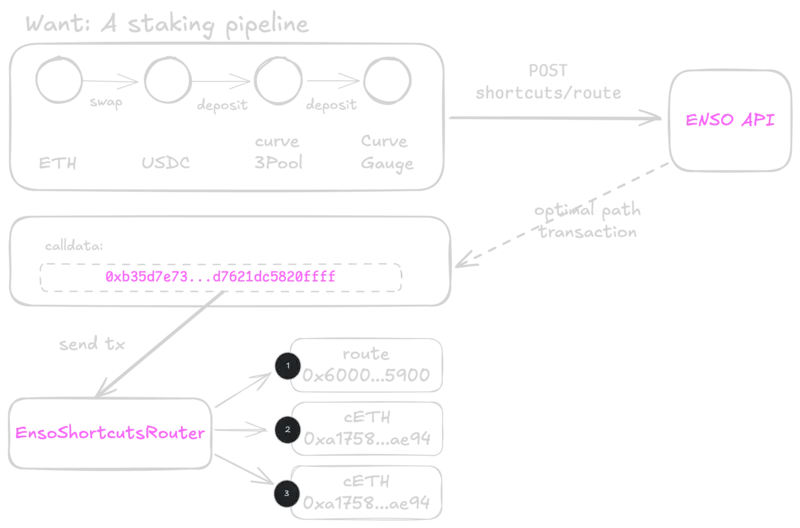
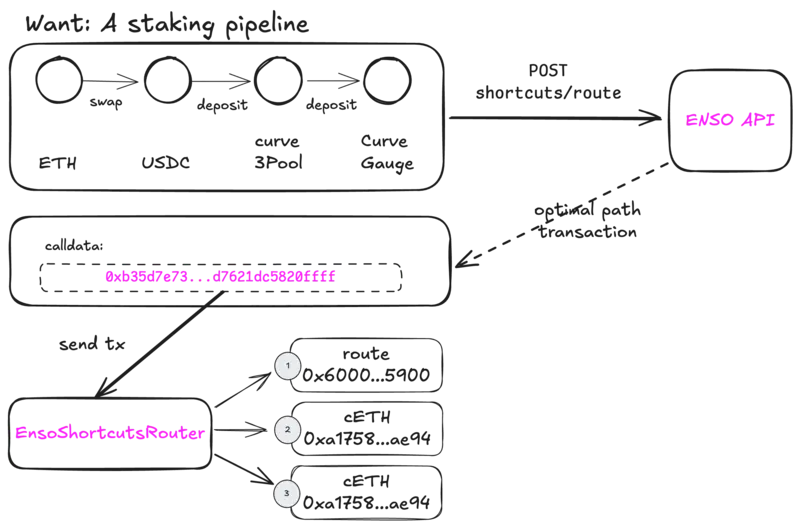
If Enso should choose the entire path into one destination, start with the Route API. See Route API vs Bundle API before building a custom sequence.
Before you start
- Create and verify an API key.
- Choose a supported chain, protocol, and public action.
- Use the Bundle Actions Reference for action inputs and outputs.
- Use supported actions and the per-protocol action endpoint for current protocol availability.
Request anatomy
{ "bundle": [...] }. Wallet and execution settings belong in query parameters for REST, or in the first argument to getBundleData in the SDK.
Request options
Action structure
Every action has three fields:protocolselects the Enso meta-action or protocol integration.actionselects a public action supported by that protocol.argscontains the action-specific inputs.
deposit, redeem, or swap accepts the same fields.
Amounts and native assets
Use decimal strings in the token’s smallest base unit. Do not use JavaScript numbers for token amounts."1000000"is 1 USDC when the token has 6 decimals."1000000000000000000"is 1 ETH or one 18-decimal token.- Use
0xeeeeeeeeeeeeeeeeeeeeeeeeeeeeeeeeeeeeeeeefor the native asset.
tx.value exactly as provided.
Chain action outputs
A later action can consume an earlier action’s output:index. Some checks do not expose a normal consumable output; consult the action output table before chaining them.
Receivers and intermediate assets
The query-levelreceiver is the default recipient for final outputs. An action-level receiver overrides recipient behavior for that action when supported. refundReceiver is for dust or applicable cross-chain refunds.
Do not send every intermediate output to the user. Assets consumed by later actions must remain with the executing account until the sequence completes.
Example: route into a deposit
This source-backed example routes native ETH into rETH and deposits the route output into Aave. The deposit consumes action0 dynamically.
Example: consume an array output
split returns one output per tokenOut. The following CLMM deposit selects both outputs explicitly.
slippage checks can sit between split and depositclmm. They reference the split outputs; they do not need to appear after the final deposit.
Example: route fee
Route fees are deducted from the corresponding input amounts before routing.fee is an array aligned with amountIn; "100" is 1%.
enso:fee action.
Example: bridge callback
A bridge callback executes later on the destination chain. For supported callback bridges, the callback must begin withenso:balance; callback output references are local to the callback array.
Execute the response
Building a bundle does not submit it.- Inspect
preTransactions. Submit each required transaction before the bundle transaction. SkiptokenApprovalentries when the current allowance is sufficient. - Submit
txunchanged, includingto,data, andvalue. - Do not submit an expired quote; respect
validUntilwhen present. - For cross-chain bundles, monitor bridge and destination status after source confirmation.
Response fields
When
skipQuote=true, quote-dependent fields such as output amounts and gas may be absent.
Limits and common errors
See the FAQ and Bundle Actions Reference for action-specific constraints.
Next steps
Bundle Actions Reference
Review public action inputs, outputs, fees, checks, and composition rules.
API Reference
Inspect the exact Bundle endpoint request and response schema.
Routing Strategies
Understand execution-account and approval behavior.
Crosschain Routing
Choose bridge protocols and monitor asynchronous destination execution.